
DIGITAL PRODUCT LAUNCH
Launch Your First Digital Product
Prepare your product for a measured launch.
Bring an offer and a working product. Prepare the delivery test, release plan and review process that help you decide when the product is ready to launch.
4 text lessons · English · Self-paced
Best fit: Your offer and product exist; delivery needs a plan.
Plan 4–6 setup hours, plus your release window. Suggested plan; reading and feedback can add time.
Get Launch Your First Digital ProductUS$19 · one-time payment · full lessons + filesPurchase details
Your course, ready to open.
This course includes all its lessons and the listed project files. Other courses and software subscriptions are separate.
- Enter the email you want to use for access.
- Review the terms and continue to PayPal.
- After verified payment, open every included lesson and download your files.
Already own an included course? Restore your purchase before buying again. No automatic upgrade credit applies.
Used for purchase delivery and recovery. No account or password needed. Privacy.
Read the terms and refund policy before paying.
Availability is checked securely before checkout. Access opens after verified payment.
01 / COURSE OVERVIEW
What you will learn
- Check the files and delivery before taking payments.
- Prepare a focused launch plan and consent-based content path.
- Separate orders, receipts, costs and unknowns in the review.
Who this is for
You have made a digital product and need to organise the release and measure what happens.
02 / THE LEARNING PATH
Course curriculum
- Free lesson below
Set a readiness gate and a bounded work plan
Create a launch brief and a 14-day working plan with explicit prerequisites, owners, time and cash caps, and stop conditions.
Package usable files and test the full access path
Create a file manifest and delivery test log covering usable assets, confirmed payment access, and failure or cancellation boundaries.
Publish a useful answer and a truthful next step
Prepare one complete question-led guide and a permitted distribution plan that connects the useful answer to an accurate product page.
Review the release with counts, costs, and use evidence
Complete a release dashboard and contribution calculation, distinguish actuals from unknowns, and write the next-version or stop decision.
FREE FIRST LESSON / NO EMAIL REQUIRED
The lesson starts here
Set a readiness gate and a bounded work plan
Create a launch brief and a 14-day working plan with explicit prerequisites, owners, time and cash caps, and stop conditions.
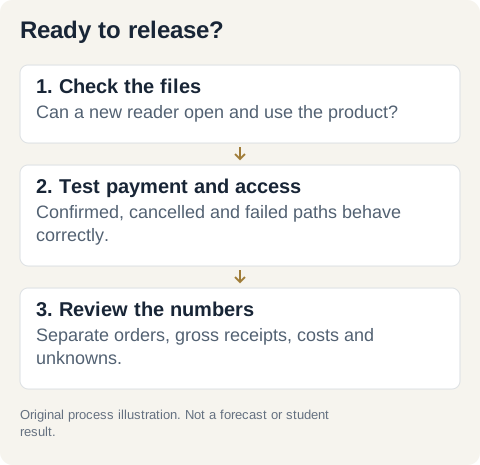
A launch is a learning and delivery cycle, not a ceremony that makes an unfinished product valuable. Start with one buyer, one task, one scoped product, and the evidence you already have. If the buyer or task is still undefined, use the Offer Research Lab first. If the product page is misleading or incomplete, work through the Sales Copy Lab before inviting purchases.
Write a launch brief: buyer, finish line, current offer version, evidence and limits, files, distribution channel, measurement, owner hours available, cash you can afford to spend, and a review date. Choose one primary measure and two guardrails. A primary measure might be completed use of the sample or paid orders from defined qualified exposures. Guardrails might be access failures and support time. They are planning choices, not industry benchmarks.
Use the 14-day sequence as a dependency map. Days 1-4 investigate the task and scope. Days 5-7 create usable files and test delivery. Days 8-10 finish the decision page and one useful public guide. Days 11-14 publish only after gates pass, observe, and write a decision. A part-time creator may need several weeks. Waiting for participants, fixing accessibility, or pausing for a missing support channel is legitimate; do not relabel unfinished work as launched to match a calendar.
A gate asks whether a necessary condition is actually met. Examples are files open, the description matches them, permission exists for demonstration inputs, checkout and access are tested, and the business can receive support requests. A checkbox is a record, not proof. Attach the artifact or test note behind it. Completion in this self-paced lab is self-reviewed work, not instructor verification. Background references provide planning context, not a prediction of business success.
Worked example
Fictional worked example — Jordan prepares a bounded release of the Interview Outline Kit. Buyer: an adult first-time host with a booked guest and topic. Output: a one-page outline. Current evidence: two fictional usability attempts in this teaching scenario, not real customer evidence. Files: walkthrough, research worksheet, question map, rehearsal checklist. Channel: one permitted demonstration post and an optional subscribed-email invitation only if the email system is ready.
Jordan allocates 18 owner hours across three calendar weeks, although the planner has 14 work slots. Cash cap: $90 for approved promotion, with no spending until the product and delivery gates pass. Primary measure: paid orders from tracked qualified product-page visitors. Guardrails: failed access attempts and support hours. Unknown: demand beyond the small initial channel.
Week one covers slots 1-4. Week two covers files and delivery. Week three covers the page, guide, observation, and decision. A pending support mailbox prevents paid publication; Jordan does not tick it complete or promise a 14-day result.
Your exercise
1. Complete the launch brief using real current facts and labeled unknowns. Attach the offer decision if one exists; otherwise record why readiness research is pending.
2. In launch-planner.xlsx, Launch Plan tab, or a plain table, assign the 14 suggested days to your actual calendar and available hours. Give each task an owner, output, dependency, and review state.
3. Choose one primary measure, define its denominator if it has one, and select two operational guardrails. Keep learning measures separate from sales measures.
4. Set maximum cash and owner hours for this cycle. Record what pauses or stops the cycle, including missing delivery, misleading claims, or a broken support route.
5. Create a readiness checklist with a link or file reference for every completed gate. Mark unresolved items Pending instead of checking them optimistically.
6. Explain which task must finish before you invite a purchase and why. Move the calendar if that dependency is not ready.
Your finished work
A launch brief, a dated task plan with dependencies, and a readiness checklist whose completed items point to evidence. A revised calendar or documented pause can be a correct outcome.
Check your work
- One buyer, task, and scoped product are defined.
- Existing evidence and unresolved assumptions are distinguished.
- Each planned task has an output, dependency, owner, and realistic work slot.
- Cash and owner-hour caps are separate and explicit.
- The primary measure and two guardrails are defined before release.
- No unresolved file, checkout, support, or accuracy gate is presented as completed.
References & further reading
Keep the project you made. Check the full course status and requirements before choosing your next step.
Review course access & files04 / YOUR NEXT STEP
Course access & project materials
4 text lessons and the following project materials are included in one purchase.
- Digital Product Launch GuidePDF
- Launch PlannerXLSX
Restore an existing purchase. Online lessons and their working files are one purchase; check overlap before buying again.
Tools and requirements
- A defined offer and a working digital product.
- A way to test your own payment and delivery process.
- A PDF reader and XLSX-compatible spreadsheet app.
Your own payment, publishing and delivery tools may charge separately. All four lessons and working files are included in the Digital Product Lab.
Format, outcomes and access
These are English text lessons with examples and practical exercises. There is no video library, personal coaching or certificate. Examples are teaching scenarios, not student results. Income, clients, sales and platform approval are not guaranteed.
Open purchases provide all included lessons immediately after verified payment. Your purchase email restores access without a password. Keep your downloaded files; permanent online hosting is not promised. Read the purchase terms before checkout.